

Molybdenum and Rhenium
IMPORTANT METALS FOR DEVELOPMENT
From engineering works to household products, molybdenum and rhenium are critical for their strength and durability.
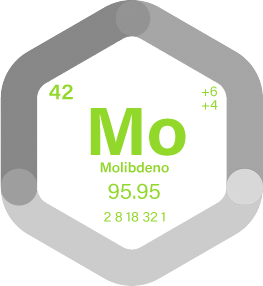
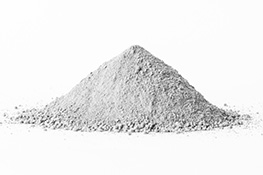
Molybdenum Key piece for industry
and essential mineral for life
Molybdenum is a naturally occurring element found on Earth and is used for a wide variety of applications in transportation, construction, power generation, agriculture, and even medicine. In small concentrations, molybdenum is also present in plants, animals and within the human body, which means that life cannot be sustained without it.
Molybdenum properties
Molybdenum has one of the highest melting temperatures of all the elements (2623°C) and is also one of the minerals with the lowest coefficient of thermal expansion (expansion), of 5.04 x 10⁻⁶ (1/K). .
Another of its most notorious characteristics is its great resistance to corrosion, since it manages to maintain its stable composition at room temperature and up to 400°C. Likewise, it resists well in non-oxidizing media, non-oxidizing mineral acids and is relatively inert to media containing hydrogen sulfide. Other products to which it resists well are iodine, bromide and chloride vapors; and to liquid metals such as bismuth, lithium, potassium and sodium. Its resistance to corrosion can even be increased by forming alloys with tungsten and chromium.
Where is molybdenum used?
Molybdenum has two types of uses: primary and final. In primary uses, it is mainly used as a material for the production of metallurgical applications -structural and stainless steels-, chemicals and pure molybdenum parts. End uses, meanwhile, refer to finished products that contain various percentages of molybdenum, which are used in the production of parts for industries such as the oil, chemical, automotive, and aeronautical industries, among others.
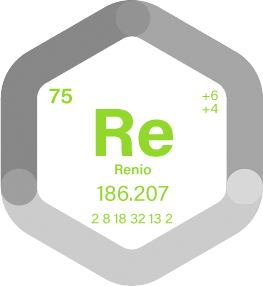
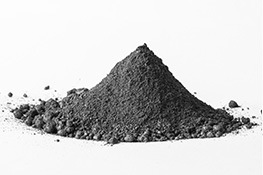
Rhenium One of the rarest metals on Earth, but essential in alloys subjected to extreme conditions
Rhenium is a highly valuable but rare metal that is rarely found in its pure state in nature. Derived from molybdenite -which in turn is a by-product of copper-, rhenium is mainly used in superalloys for the aeronautical industry and in catalysts used by oil refineries.
Rhenium properties
Highly hard and resistant to heat, rhenium has the third highest melting temperature of all the elements (3,186°C). It also has the highest boiling point (5.596°C), a high density (21.03 g/cm³), extraordinary resistance to corrosion, and is a good conductor of electricity and heat. Its high coefficient of elasticity allows it to remain stable and rigid under high stress conditions, a quality that is transferred to the alloys that contain it.
Where is rhenium used?
Most of the rhenium produced in the world goes to the development of superalloys, which are used to make turbine blades for aircraft engines and industrial gas turbines.
A second use of rhenium is for the catalysis of platinum in the oil industry, which makes it possible to produce lead-free high-octane gasoline.
Finally, rhenium is used in the manufacture of electrical contact points, heating parts, rocket motor parts and, increasingly, in medical supplies and procedures, among other applications.
You want to know more?
Contact us at (+56) 22 937 6000 or complete the form. Our team will contact you quickly.